
JEE Questions & Answers
Q001
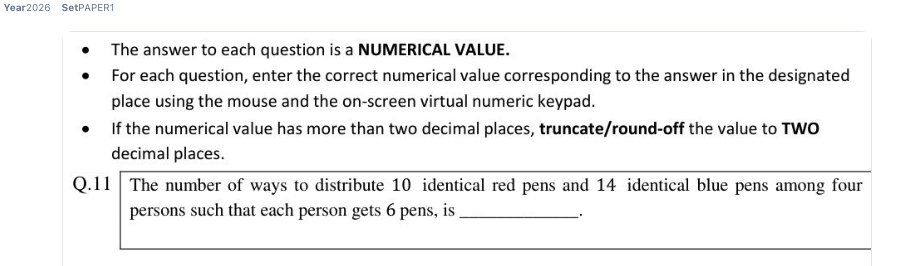
Step 1: Rewrite the equation \(\sqrt{3} a \cos x + 2 b \sin x = c\) as a linear combination of sine and cosine, and compare it to the standard form \(R\cos(x - \theta)\) where \(\tan \theta = \frac{2b}{\sqrt{3}a}\).
Step 2: Use the identity for the sum of roots of a trigonometric equation, which is \(2\alpha = \frac{\pi}{3}\), in the interval \(\left[-\frac{\pi}{2}, \frac{\pi}{2}\right]\), so finding the roots requires \(\cos^{-1}\left(\frac{c}{R}\right)\) and \(-\cos^{-1}\left(\frac{c}{R}\right)\).
Step 3: Given that \(\alpha + \beta = \frac{\pi}{3}\), solve for \(\tan\left(\frac{\pi}{3}\right) = \frac{\sin \frac{\pi}{3}}{\cos \frac{\pi}{3}} = \frac{\frac{\sqrt{3}}{2}}{\frac{1}{2}} = \sqrt{3}\). Thus, \(\frac{2b}{\sqrt{3}a} = \sqrt{3}\), which simplifies to \(b = a\).
Final Answer: \(\frac{b}{a} = 1.00\)
Q002
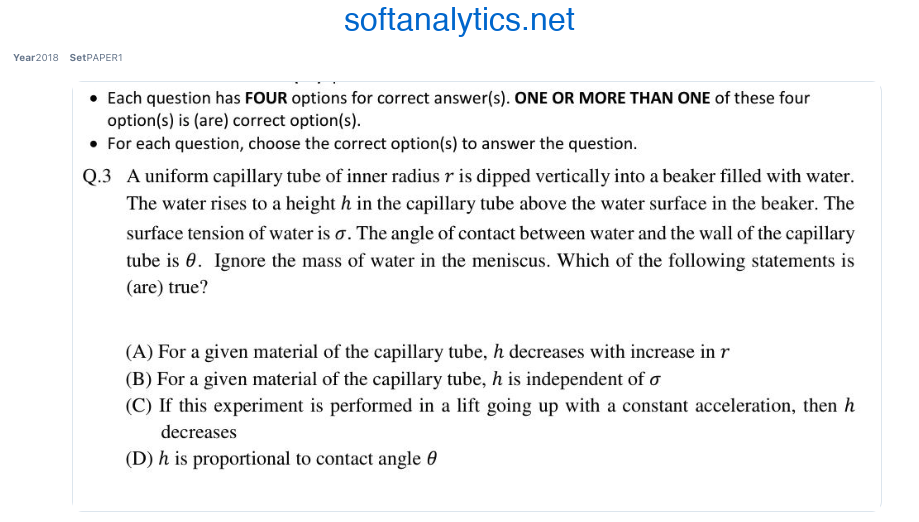
(A) For a given material of the capillary tube, \( h \) decreases with increase in \( r \)
(B) For a given material of the capillary tube, \( h \) is independent of \( \sigma \)
(C) If this experiment is performed in a lift going up with a constant acceleration, then \( h \) decreases
(D) \( h \) is proportional to contact angle \( \theta \)
Step 1: The height \( h \) to which the liquid rises in a capillary tube is given by the formula:
$$ h = \frac{2\sigma \cos \theta}{\rho g r} $$ where \( \rho \) is the density of the liquid and \( g \) is the acceleration due to gravity.Step 2: Analyzing each statement:
(A) \( h \) is inversely proportional to \( r \), so \( h \) decreases with an increase in \( r \). This statement is true.
(B) \( h \) is directly proportional to \( \sigma \), so it is not independent of \( \sigma \). This statement is false.
(C) If the lift is going up with an acceleration \( a \), effective gravity becomes \( g_{\text{eff}} = g + a \). Thus, \( h \) is given by:
$$ h = \frac{2\sigma \cos \theta}{\rho (g + a) r} $$ Hence, \( h \) decreases. This statement is true.(D) \( h \) is proportional to \( \cos \theta \), not directly to \( \theta \). Therefore, this statement is false.
Final Answer: The true statements are (A) and (C).
Q003
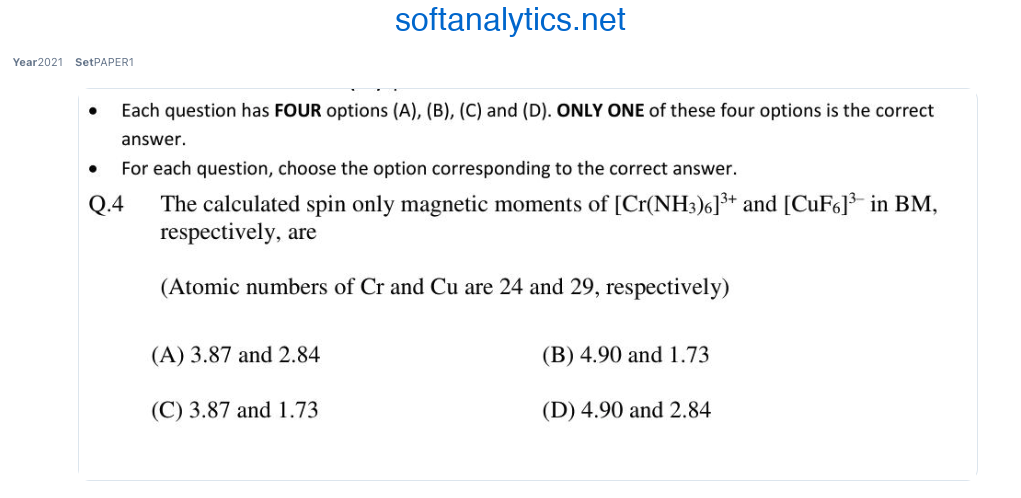
Step 1: Determine the oxidation state and electron configuration of Cr in [Cr(NH3)6]3+.
Cr in [Cr(NH3)6]3+ has an oxidation state of +3, so its electronic configuration is [Ar] 3d3. This gives 3 unpaired electrons.
Step 2: Calculate the spin-only magnetic moment for [Cr(NH3)6]3+.
The spin-only magnetic moment \(\mu\) is calculated using the formula:
$$ \mu = \sqrt{n(n+2)} \, \text{BM} $$where \(n\) is the number of unpaired electrons.
For 3 unpaired electrons:
$$ \mu = \sqrt{3(3+2)} = \sqrt{15} \approx 3.87 \, \text{BM} $$Step 3: Determine the oxidation state and electron configuration of Cu in [CuF6]3-.
Cu in [CuF6]3- has an oxidation state of +3, so the electronic configuration is [Ar] 3d8. This gives 2 unpaired electrons.
Step 4: Calculate the spin-only magnetic moment for [CuF6]3-.
$$ \mu = \sqrt{2(2+2)} = \sqrt{8} \approx 2.84 \, \text{BM} $$Final Answer: (A) 3.87 and 2.84
Q004
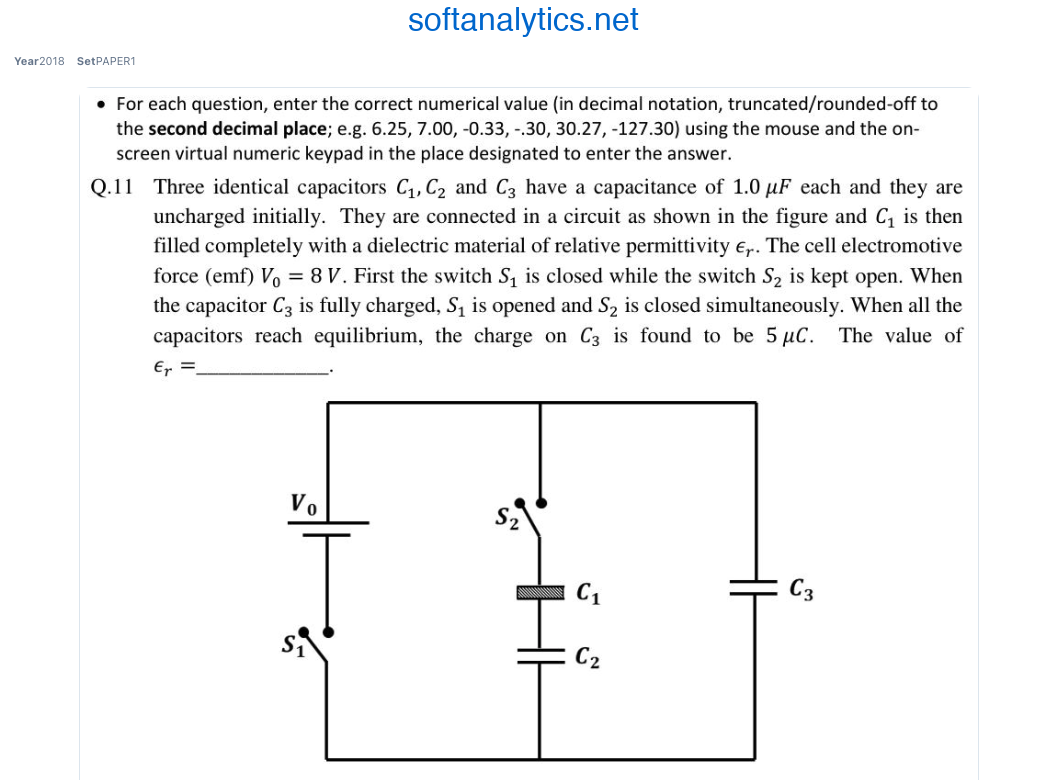
Step 1: Calculate the initial charge on capacitor \(C_3\) when \(S_1\) is closed and \(S_2\) is open. The capacitance between \(C_3\) and the series combination of \(C_1\) and \(C_2\) is \(C_{eq} = 1 \, \mu F + \frac{1}{\frac{1}{1} + \frac{1}{1}} \, \mu F = 1 \, \mu F + 0.5 \, \mu F = 1.5 \, \mu F\). The charge is \(Q = C_{eq} \cdot V_0 = 1.5 \, \mu F \times 8 \, \text{V} = 12 \, \mu C\).
Step 2: When \(S_1\) is opened and \(S_2\) is closed, the charge redistributes between \(C_1\), which has a dielectric, and \(C_3\). Let the effective capacitance of \(C_1\) be \(C_{1}' = \varepsilon_r \times 1\, \mu F\). The total charge \(12 \, \mu C\) is now shared between \(C_1'\) and \(C_3\).
Step 3: Set up the equation for charge distribution: \(Q_3 = \frac{C_3}{C_1' + C_3} \times 12 \, \mu C = 5 \, \mu C\). Given \(C_3 = 1 \, \mu F\), solve \( \frac{1}{\varepsilon_r + 1} \times 12 = 5\).
Step 4: Solve \(\frac{12}{\varepsilon_r + 1} = 5\). Multiply to clear the fraction: \(12 = 5(\varepsilon_r + 1)\), leading to \(\varepsilon_r = \frac{12}{5} - 1 = \frac{7}{5} = 1.4\).
Final Answer: \(\varepsilon_r = 1.40\).
Q005
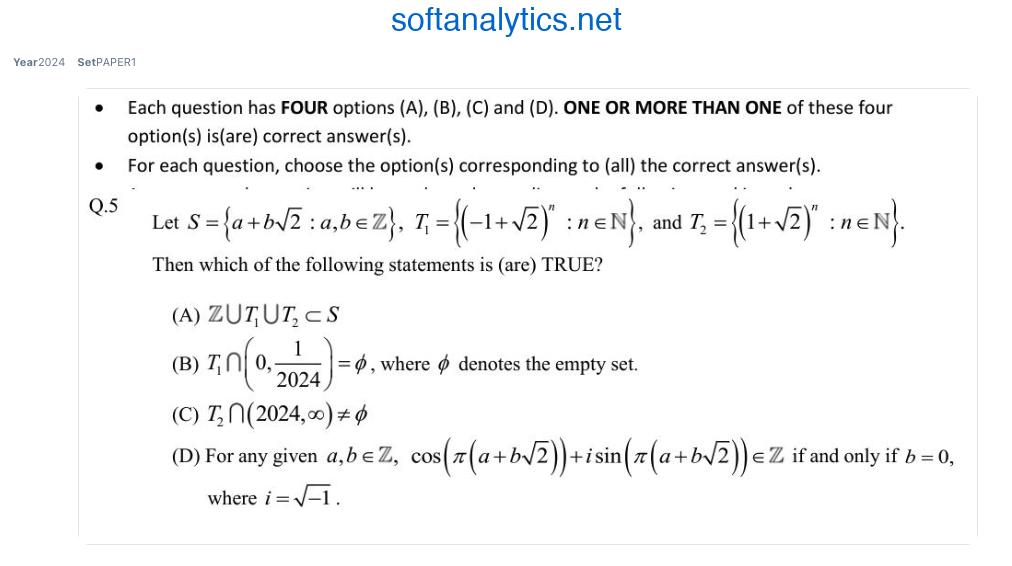
(A) \( \mathbb{Z} \cup T_1 \cup T_2 = S \)
(B) \( T_1 \cap \left(0, \frac{1}{2024}\right) = \emptyset \), where \( \emptyset \) denotes the empty set.
(C) \( T_2 \cap (2024, \infty) eq \emptyset \)
(D) For any given \( a, b \in \mathbb{Z} \), \( \cos\left(\pi(a + b\sqrt{2})\right) + i\sin\left(\pi(a + b\sqrt{2})\right) \in \mathbb{Z} \) if and only if \( b = 0 \), where \( i = \sqrt{-1} \).
Step 1: Analyze statement (A). \( S = \{ a + b\sqrt{2} : a, b \in \mathbb{Z} \} \) denotes all numbers of the form \( a + b\sqrt{2} \). Since \( T_1 \) and \( T_2 \) are subsets of \( S \), the union \( \mathbb{Z} \cup T_1 \cup T_2 \subset S \), and not equal to \( S \). Hence, (A) is False.
Step 2: Analyze statement (B). \( T_1 = \{ (-1 + \sqrt{2})^n : n \in \mathbb{N} \} \) and its terms are of the form \( x^n \) where \( -1 < (-1 + \sqrt{2}) < 0 \). Hence none of the elements are positive, confirming \( T_1 \cap \left(0, \frac{1}{2024}\right) = \emptyset \). Thus, (B) is True.
Step 3: Analyze statement (C). Since \( T_2 = \{ (1 + \sqrt{2})^n : n \in \mathbb{N} \} \) and \( 1 + \sqrt{2} > 2 \), for large \( n \), elements grow exponentially. So indeed, there exist elements in \( (2024, \infty) \). Hence, (C) is True.
Step 4: Analyze statement (D). The expression \( \cos(\pi(a + b\sqrt{2})) + i\sin(\pi(a + b\sqrt{2})) \) simplifies to an integer form, equivalent to Euler's formula \( e^{i\theta} \) being real if and only if \( \theta = n\pi \) (an integer multiple of \( \pi \)), implying \( a + b\sqrt{2} \in \mathbb{Z} \). This implies \( b = 0 \). Hence, (D) is True.
Final Answer: B, C, and D are True.