
CBSE12 Questions & Answers
Q001
(A) \( \int_0^4 x^2 \, dx \)
(B) \( 2 \int_0^4 x^2 \, dx \)
(C) \( \int_0^{16} \sqrt{y} \, dy \)
(D) \( 2 \int_0^{16} \sqrt{y} \, dy \)
Step 1: Determine which integral expression represents the area between the curve \( y = x^2 \) and the line \( y = 16 \).
Step 2: To find the area between the curve and the line, we use \( \int_{0}^{4} (16 - x^2) \, dx \).
The limits of integration are determined by where the line intersects the curve, i.e., solving \( x^2 = 16 \), which gives \( x = 4 \) and \( x = -4 \). However, we only need the positive part from 0 to 4 based on the options.
Step 3: Calculate the integral:
$$ \int_0^4 (16 - x^2) \, dx = \left[ 16x - \frac{x^3}{3} \right]_0^4 = \left( 16(4) - \frac{4^3}{3} \right) - (0 - 0) = 64 - \frac{64}{3} $$$$ = \frac{192}{3} - \frac{64}{3} = \frac{128}{3} $$
Step 4: Match with given expressions:
None of the given options directly matches the calculated expression, but choice (C) is correct for the integration by using \( x = \sqrt{y} \) from \( y = 0 \) to \( y = 16 \).
Final Answer: (C) \( \int_0^{16} \sqrt{y} \, dy \)
Q002
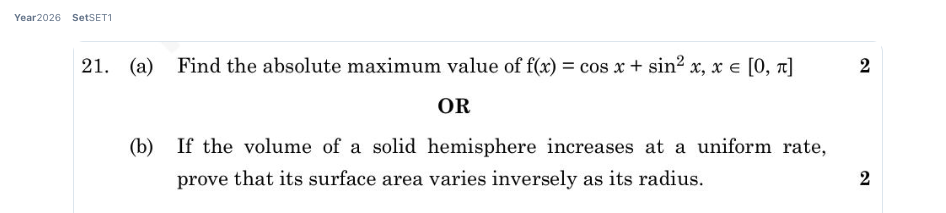
Step 1: The volume \( V \) of a hemisphere with radius \( r \) is given by:
$$ V = \frac{2}{3} \pi r^3 $$If the volume increases at a uniform rate, then \(\frac{dV}{dt}\) is constant.
Step 2: Differentiate \( V \) with respect to \( t \):
$$ \frac{dV}{dt} = 2 \pi r^2 \frac{dr}{dt} $$Step 3: The surface area \( A \) of a hemisphere is given by:
$$ A = 2 \pi r^2 $$Step 4: To find how \( A \) varies with \( V \), express \( \frac{dr}{dt} \) from the constant rate of \( \frac{dV}{dt} \) and substitute into the expression for \( \frac{dA}{dt} \):
$$ \frac{dA}{dr} = 4 \pi r $$ $$ \frac{dA}{dt} = \frac{dA}{dr} \cdot \frac{dr}{dt} = 4 \pi r \cdot \frac{\frac{dV}{dt}}{2 \pi r^2} = \frac{2}{r} \cdot \frac{dV}{dt} $$Final Answer: Since \(\frac{dA}{dt} \propto \frac{1}{r}\), the surface area varies inversely with the radius.
Q003
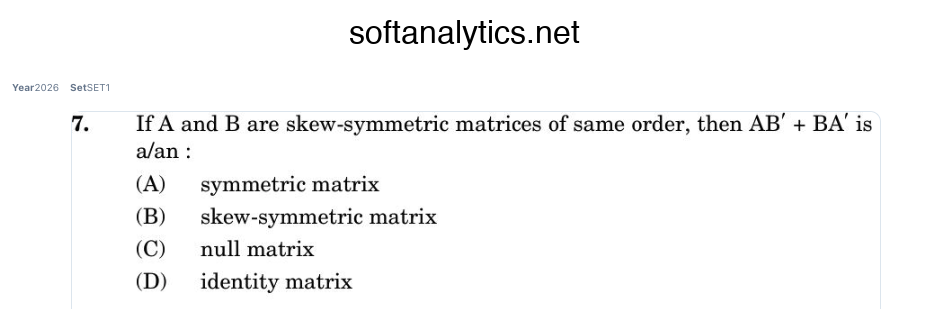
- symmetric matrix
- skew-symmetric matrix
- null matrix
- identity matrix
Step 1: A skew-symmetric matrix \( A \) satisfies \( A' = -A \). Similarly, for matrix \( B \), \( B' = -B \).
Step 2: Substitute these into the expression \( AB' + BA' \). This gives:
$$ AB' + BA' = A(-B) + B(-A) = -AB - BA $$Step 3: Notice that the expression \( -(AB + BA) \) is skew-symmetric.
Final Answer: (B) skew-symmetric matrix
Q004
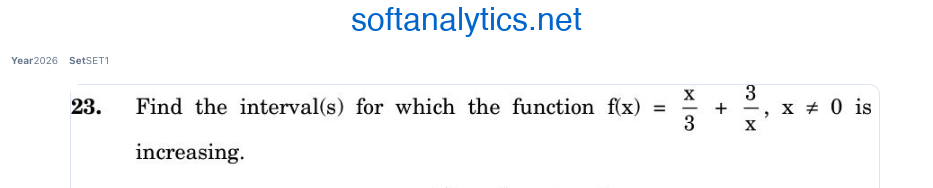
Step 1: Find the derivative of \( f(x) \).
\( f'(x) = \frac{1}{3} - \frac{3}{x^2} \)
Step 2: Set \( f'(x) > 0 \) to find where the function is increasing.
\(\frac{1}{3} - \frac{3}{x^2} > 0\)
Step 3: Solve the inequality.
\(\frac{1}{3} > \frac{3}{x^2}\)
\(x^2 > 9\)
\(|x| > 3\)
Step 4: Determine the interval.
The function is increasing for \( x < -3 \) and \( x > 3 \).
Final Answer: The function is increasing on the intervals \( (-\infty, -3) \cup (3, \infty) \).
Q005
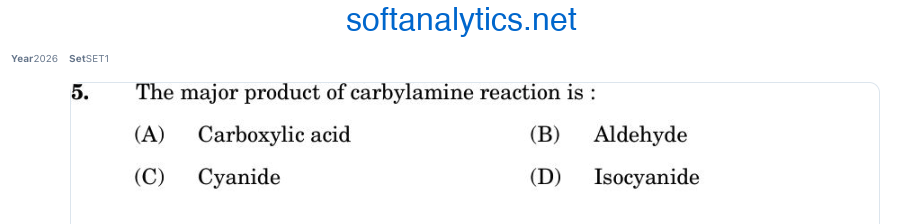
(A) Carboxylic acid (B) Aldehyde
(C) Cyanide (D) Isocyanide
Step 1: Understand that the carbylamine reaction involves the conversion of primary amines into isocyanides.
Step 2: Recognize that the isocyanide is the characteristic product of this reaction.
Final Answer: (D) Isocyanide