
CBSE10 Questions & Answers
Q001

(A) 4
(B) 6
(C) 2
(D) 0
Step 1: Calculate the last digits of the powers of 2 starting from \(2^1\).
The sequence of last digits for the powers of 2 is: 2, 4, 8, 6, 2, 4, 8, 6, ... (repeating pattern every 4 numbers).
Step 2: Analyze the last digits.
The recurring last digits pattern is: 2, 4, 8, 6. It never ends with 0.
Final Answer: (D) 0
Q002
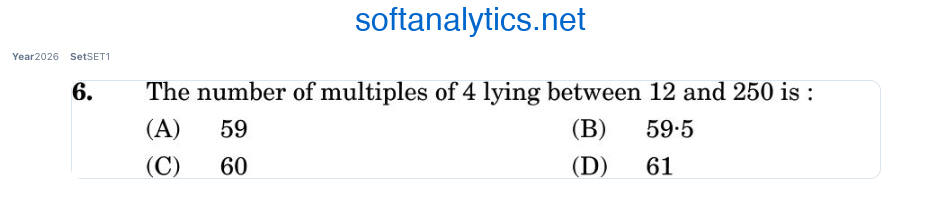
- (A) 59
- (B) 59.5
- (C) 60
- (D) 61
Step 1: Find the first multiple of 4 greater than 12.
The first multiple is \(16\) because \(12 \div 4 = 3\) remainder 0, so the next multiple is \(4 \times 4 = 16\).
Step 2: Find the last multiple of 4 less than 250.
The last multiple is \(248\) because \(248 \div 4 = 62\), making \(4 \times 62 = 248\).
Step 3: Calculate the number of multiples between 16 and 248.
The multiples of 4 form an arithmetic sequence: \(4 \times 4, 4 \times 5, \ldots, 4 \times 62\).
The number of terms \(n\) in the sequence is calculated as:
$$ n = \left(\frac{248 - 16}{4}\right) + 1 = \left(\frac{232}{4}\right) + 1 = 58 + 1 = 59.$$
Final Answer: The number of multiples of 4 between 12 and 250 is 59. The correct option is (A) 59.
Q003
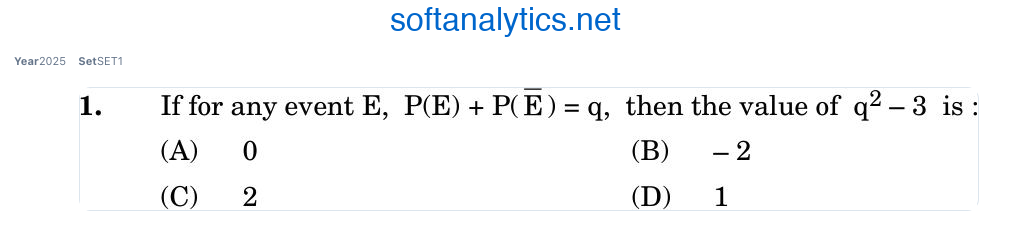
- (A) 0
- (B) -2
- (C) 2
- (D) 1
Step 1: For any event \( E \), it is known that \( P(E) + P(\overline{E}) = 1 \) because the sum of probabilities of an event and its complement is always 1.
Step 2: Given that \( q = P(E) + P(\overline{E}) \), we have \( q = 1 \).
Step 3: Calculate \( q^2 - 3 \):
$$q^2 - 3 = 1^2 - 3 = 1 - 3 = -2.$$Final Answer: -2 (Option B)
Q004
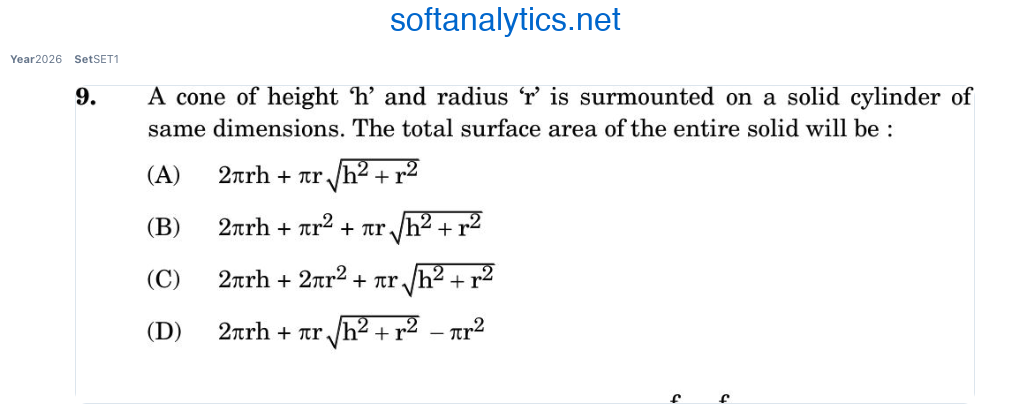
(A) \( 2\pi rh + \pi r \sqrt{h^2 + r^2} \)
(B) \( 2\pi rh + \pi r^2 + \pi r \sqrt{h^2 + r^2} \)
(C) \( 2\pi rh + 2\pi r^2 + \pi r \sqrt{h^2 + r^2} \)
(D) \( 2\pi rh + \pi r \sqrt{h^2 + r^2} - \pi r^2 \)
Step 1: Compute the lateral surface area of the cylinder, which is \( 2\pi rh \).
Step 2: Compute the lateral surface area of the cone. The slant height \( l \) is \( \sqrt{h^2 + r^2} \). Therefore, the lateral surface area is \( \pi r \sqrt{h^2 + r^2} \).
Step 3: Add the base area of the cylinder, which is \( \pi r^2 \), since the top base of the cylinder is not exposed due to the cone.
Step 4: Add all the areas calculated:
\[ 2\pi rh + \pi r \sqrt{h^2 + r^2} + \pi r^2 \]
Final Answer: \( 2\pi rh + \pi r^2 + \pi r \sqrt{h^2 + r^2} \) (Option B)
Q005
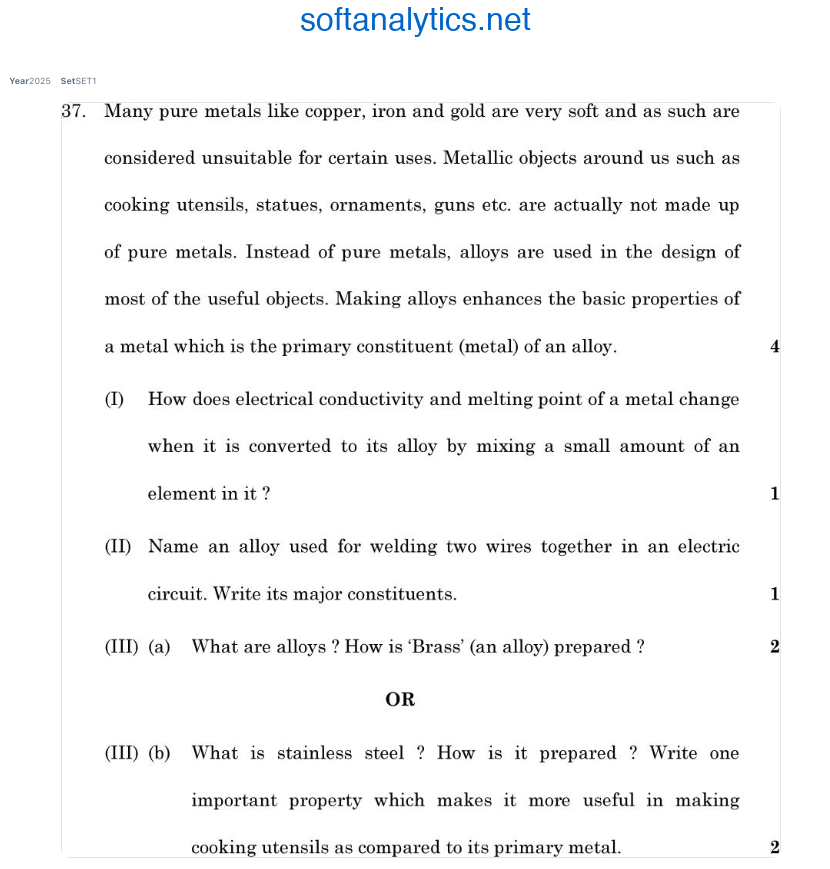
(I) How does electrical conductivity and melting point of a metal change when it is converted to its alloy by mixing a small amount of an element in it?
(II) Name an alloy used for welding two wires together in an electric circuit. Write its major constituents.
(III) (a) What are alloys? How is 'Brass' (an alloy) prepared?
OR
(III) (b) What is stainless steel? How is it prepared? Write one important property which makes it more useful in making cooking utensils as compared to its primary metal.
Step 1: Analyze how electrical conductivity and melting point are affected when a pure metal is converted to its alloy.
When a pure metal is alloyed, its electrical conductivity generally decreases because the presence of different atoms disrupts the regular metallic lattice, thus impeding the free flow of electrons. The melting point usually changes as well, often increasing due to the strength and complexity of the new atomic bonds formed.
Step 2: Identify an alloy used for welding in electrical circuits and note its constituents.
A commonly used alloy for welding electrical wires is Solder. Its major constituents are tin (Sn) and lead (Pb).
Step 3: Define what alloys are and how 'Brass' is prepared.
Alloys are homogeneous mixtures of two or more metals, or a metal and non-metal, designed to have improved properties over pure metals. Brass is an alloy made by mixing copper (Cu) and zinc (Zn).
Step 4: If opting for the question about stainless steel, define it, its preparation process, and its key property.
Stainless steel is an alloy primarily composed of iron (Fe), chromium (Cr), and often nickel (Ni). It is prepared by adding these elements into pure iron during the steel-making process. Its resistance to corrosion and rust makes it more useful in making cooking utensils than pure iron.
Final Answer:
(I) Electrical conductivity decreases and the melting point typically increases when a metal is alloyed.
(II) Solder is an alloy used in wiring, composed mainly of tin and lead.
(III) (a) Alloys are mixtures of metals. Brass is prepared using copper and zinc.
OR
(III) (b) Stainless steel is made of iron, chromium, and nickel, and its corrosion resistance makes it ideal for cooking utensils.
Q006
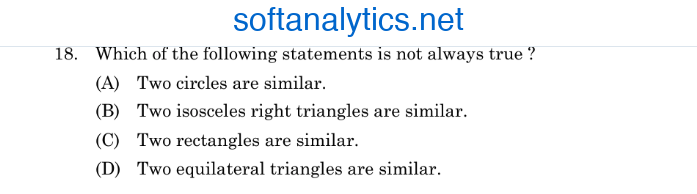
Which of the following statements is not always true?
(A) Two circles are similar.
(B) Two isosceles right triangles are similar.
(C) Two rectangles are similar.
(D) Two equilateral triangles are similar.
Step 1: Any two circles are similar because one can be obtained from the other by scaling.
Step 2: Every isosceles right triangle has angles \(45^\circ, 45^\circ,\) and \(90^\circ\), so any two such triangles are similar by the AA criterion.
Step 3: Every equilateral triangle has three \(60^\circ\) angles, so any two equilateral triangles are similar.
Step 4: Although all rectangles have four right angles, their length-to-width ratios may differ. For example, a \(2 \times 1\) rectangle is not similar to a \(3 \times 1\) rectangle.
Final Answer: \(\boxed{\text{(C) Two rectangles are similar.}}\) This statement is not always true.